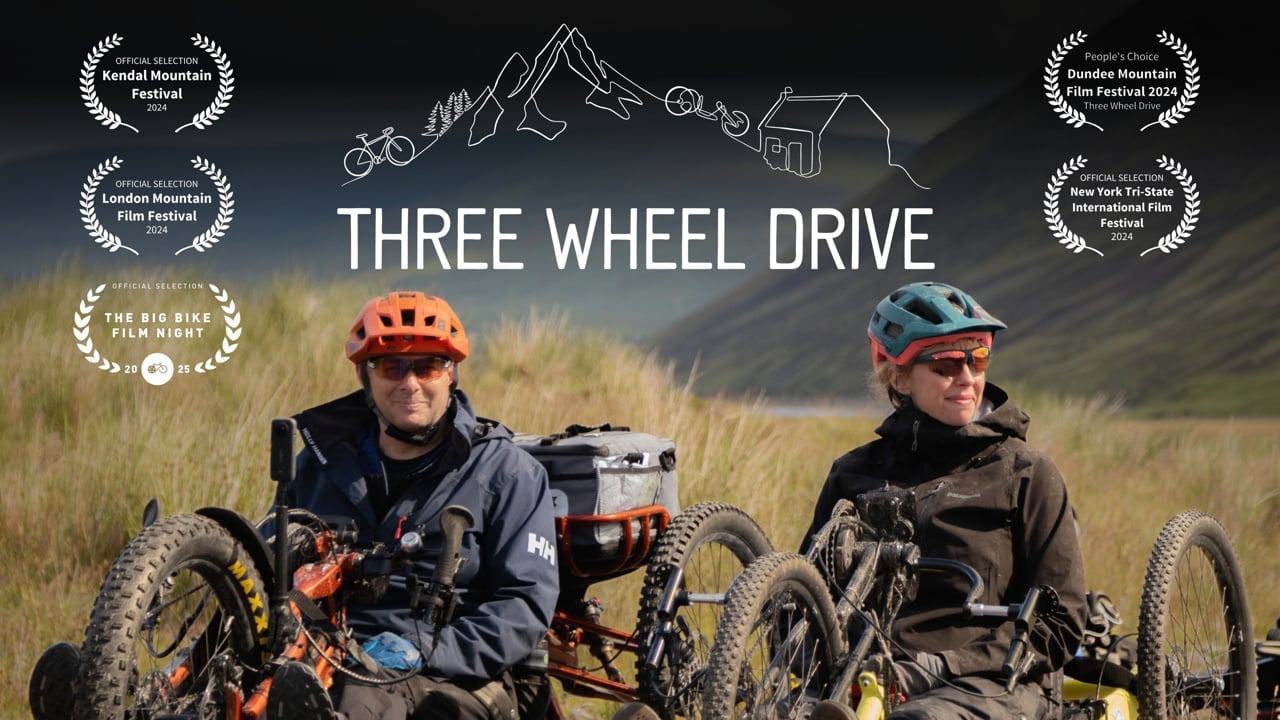
Adaptive sport documentary in Scotland is thin on the ground. Most of what exists online about disability and mountain biking is short-form and promotional: a clip, a caption, a call to donate. Three Wheel Drive, the film we made with the Adaptive Riders Collective, set out to do something different. It was selected for the Kendal Mountain Festival, the London Mountain Film Festival and the New York Tri-State International Film Festival in 2024, won the People’s Choice award at the Dundee Mountain Film Festival the same year, and was selected for The Big Bike Film Night in 2025. The film is about adaptive mountain biking and about a harder question underneath it, which is who gets to access Scotland’s wild places on a bike, and on what terms.
Why the standard treatment fails the subject
There is a well-worn template for filming disability sport, and it leans on one register: triumph over adversity, set to music, resolved in under two minutes. It is not dishonest exactly, but it is thin. It treats the rider’s disability as the whole story and the riding itself as incidental, a backdrop to the achievement of simply being there. Anyone who has spent time with adaptive riders knows that gets the emphasis backwards. The riding is the point. The terrain, the line choices, the mechanical adaptation of the bike itself, the same things that matter in any mountain biking film, matter here too, and a film that skips past them in favour of an emotional beat is not taking the sport seriously.
That is the same failure mode Comfort Zones, our documentary on steep skiing at Glenshee, was built to avoid. That film refused to let a montage stand in for an explanation of why people ski terrain where a fall has consequences, and brought in two academic philosophers rather than accept the genre’s usual answer that the reason is obvious. Three Wheel Drive works from the same instinct, applied to a different question: access rather than risk, but the same refusal to let the interesting part go unexamined.
Two forms of testimony, one film
Three Wheel Drive combines action cinematography with personal testimony, and the two do different jobs. The action has to be filmed as sport, not as spectacle: line choice, terrain reading, the specific mechanics of how an adapted bike handles ground that was never built with it in mind. Get that part soft and the film is condescending before anyone has spoken a word, because it says the riding does not need to be taken seriously on its own terms.
The testimony carries the argument the riding cannot make by itself, which is about access. Scotland’s outdoor access laws are unusually generous by international standards, but a legal right to roam and a physically rideable trail are two different things, and the gap between them is where the film’s real subject sits. That gap is not visible in a wide shot of a hill. It has to be said, by the people who run into it, in their own words and at enough length to be an argument rather than a soundbite.
What this asks of a crew
Filming action and testimony inside one production means planning for both from the first recce rather than treating the interview as something to fit in around the “real” filming. It also means the usual sport-filming discipline of anticipation, reading where a rider is about to be rather than reacting to where they have just been, has to be recalibrated for equipment and terrain that behaves differently from a standard mountain bike. That same principle, understanding the sport well enough to be in position before the moment happens rather than chasing it afterwards, is the one we set out at length in our piece on sport filmmaking from the inside, and it holds here, adjusted for a different machine and a different line.
A subject, not a texture
The clearest overlap with Comfort Zones is not stylistic, it is a decision about what the film is for. Comfort Zones treated the psychology of risk as a subject rather than a texture: something the film had to explain, not merely illustrate. Three Wheel Drive does the same with access. It would have been easy to make a film that used adaptive mountain biking as a striking image, wild scenery plus an unusual bike, without ever engaging with the question of why that image is unusual in the first place. The harder and more useful version treats access itself as the thing worth investigating, and lets the riding demonstrate the answer rather than illustrate a caption.
Adaptive sport documentary in Scotland, and where it fits
Three Wheel Drive sits inside the same territory as our wider documentary production work: sport, landscape and a subject that deserves serious treatment, rather than a promotional short with a documentary tone borrowed for credibility. It is one of the films we point to when a client asks what “serious treatment” actually means in practice, because the standard for a subject like this is set by the film that resists the easy version, not the one that takes it.
If you are developing a documentary about sport, access or a subject you believe deserves more than a promotional treatment, our documentary production page sets out how we approach that kind of commission, and the Comfort Zones case study shows the same principle applied to a different question.
Frequently asked questions
What is Three Wheel Drive about?
Three Wheel Drive is a documentary made with the Adaptive Riders Collective about adaptive mountain biking and the question of who gets to access Scotland’s wild places on a bike. It combines action cinematography of the riding itself with personal testimony from the riders on what that access does and does not look like in practice.
Does Morrocco Media film disability and adaptive sport?
Yes. Three Wheel Drive is part of our documentary work, and the same principles that apply to any sport documentary we make apply here: the sport is filmed and understood on its own terms, and testimony is given the length it needs to carry an argument rather than compressed into a promotional beat.
What makes adaptive sport documentary different from standard sport filming?
The riding itself is filmed with the same discipline as any mountain biking documentary: reading the line, anticipating the moment, respecting the terrain. What changes is the testimony, which has to carry a second argument alongside the sport, about access and about the gap between a legal right to be somewhere and a trail that is actually rideable. That argument only lands if the people affected by it are given the time on camera to make their own case.